What Color Is the Hottest Part of a Flame?
Quick Answer
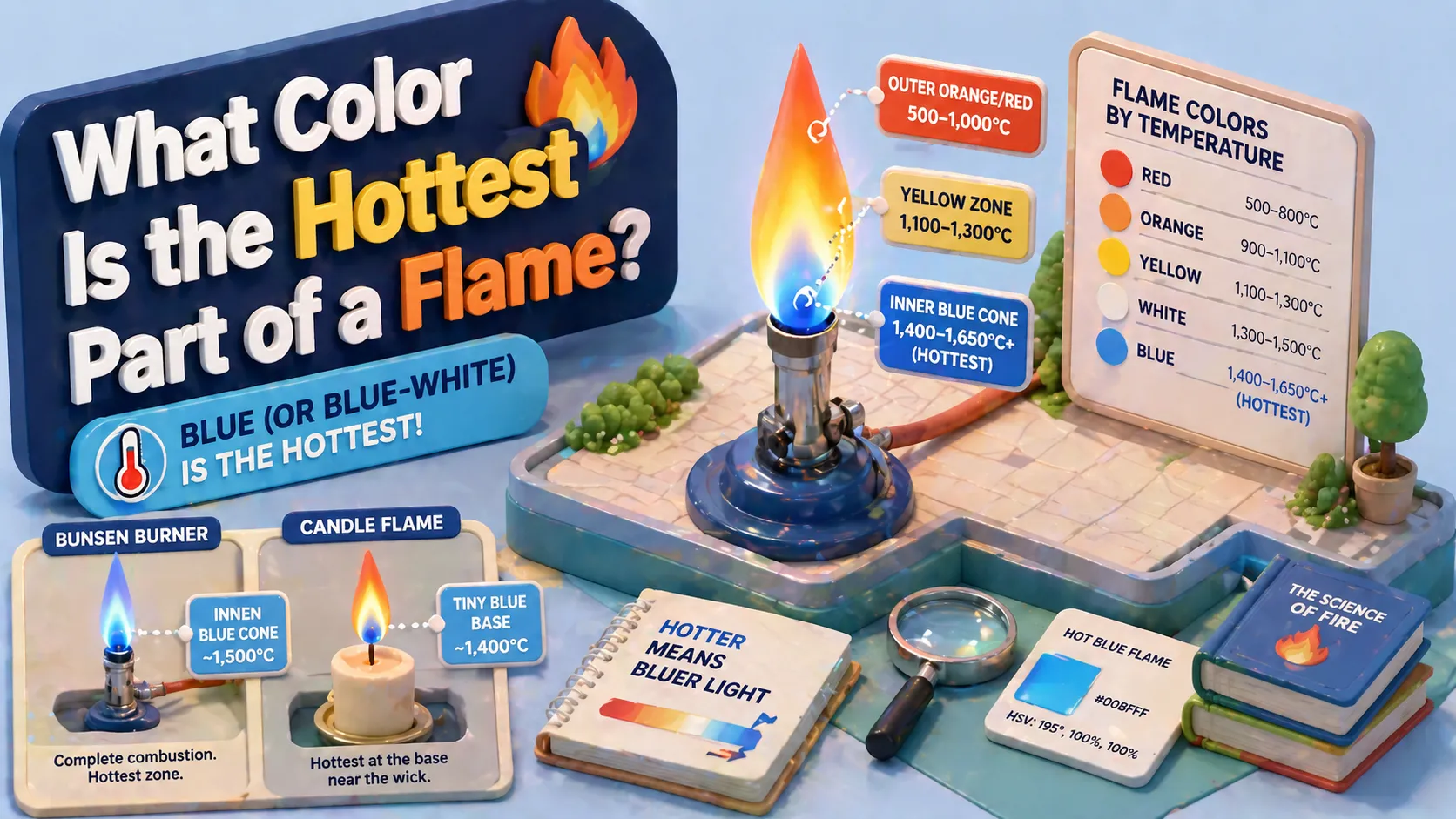
The hottest part of a typical flame is blue (or blue-white), reaching temperatures around 1,400–1,650°C (2,550–3,000°F) in complete combustion. This occurs where fuel mixes efficiently with oxygen. Orange and yellow flames are cooler (around 1,000–1,200°C), while red is the coolest visible part. The color comes from blackbody radiation and excited chemical particles. Understanding this helps train your eye for precise color temperature perception — a skill directly useful in Dialed Color Game when matching subtle hue and value shifts.
Why This Matters for Color Perception
Flame colors demonstrate how temperature influences perceived hue. In real-world color work, this knowledge improves your ability to judge warm vs cool tones, create realistic lighting in digital art, or design palettes with convincing heat and glow effects. In Dialed Color Game, recreating flame-inspired colors forces you to distinguish tiny differences in blue saturation and brightness — training the exact visual memory that designers and artists rely on daily.
How It Works
Flame color results from two main processes:
- Blackbody radiation: As temperature rises, the emitted light shifts from red → orange → yellow → white → blue (following Wien’s Law).
- Chemiluminescence: Excited molecules (like CH radicals in hydrocarbon flames) emit specific wavelengths, enhancing the blue in oxygen-rich zones.
Temperature by color (approximate):
- Red: 500–800°C
- Orange: 900–1,100°C
- Yellow: 1,100–1,300°C
- White: 1,300–1,500°C
- Blue: 1,400–1,650°C+ (hottest visible part)
Practical Examples
- Bunsen burner: The inner blue cone is the hottest zone (~1,500°C). The outer yellow tip is incomplete combustion and much cooler.
- Candle flame: Tiny blue base (~1,400°C) at the wick, surrounded by yellow (1,000°C), with orange-red outer edges.
Color values for reference:
- Hot blue flame:
#00BFFF(Deep Sky Blue) → HSV: 195°, 100%, 100% - Typical candle yellow:
#FFBF00→ HSV: 45°, 100%, 100%
When matching these in design software or Dialed, notice how the blue requires high saturation and specific hue positioning, while yellows drift easily in memory toward orange.
Common Mistakes
- Assuming red/orange is hottest (cultural bias from embers and warning colors).
- Ignoring context: background contrast makes blue flames appear darker or lighter than they are.
- Over-saturating digital flame colors: real hot blue flames are often pale or cyan-tinted, not deep navy.
- Forgetting value shifts: the brightest part isn’t always the hottest — pure white can be very hot but slightly cooler than the cleanest blue zones.
How To Train Your Eye
- Study real flames or high-quality reference photos, then recreate the hottest blue zone from memory using HSV sliders.
- Practice gradient matching: recreate smooth temperature transitions from red base to blue tip.
- Compare side-by-side: place flame colors against neutral gray to judge true hue without simultaneous contrast interference.
- Play Dialed Color Game with flame-inspired targets — focus on locking precise blue hues (around 190°–210°) and high brightness while controlling saturation drift.
Mastering flame color science sharpens your overall color memory and gives you more natural, convincing results in any creative work involving light, heat, or atmosphere.
Continue Reading
More guides, comparisons, and explainers related to the same games and topics.
Related Games
Browse games connected to the ideas, mechanics, or categories covered in this article.