Toon Tone
Loading game...
What is Toon Tone games?
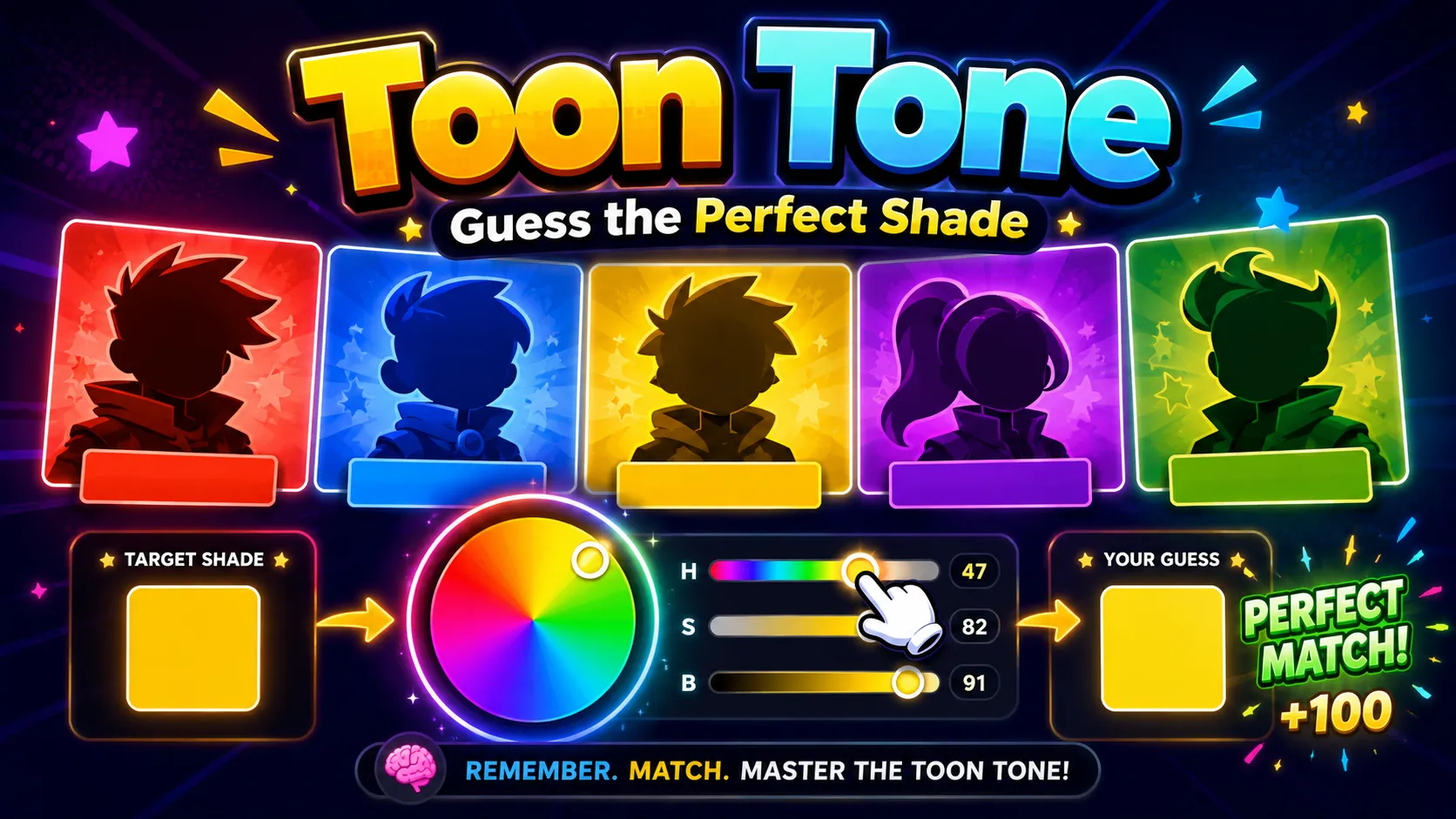
Toon Tone games is a minimalist color-guessing challenge built around one deceptively simple question: how well do you actually remember the colors of famous cartoon characters? The game shows you five characters, then asks you to recreate their perfect shades using color controls.
The trap is that memory lies. You may remember a character as “blue,” “yellow,” or “green,” but Toon Tone games demands the exact feeling of that color: the hue, the saturation, and the brightness. A shade that looks close in your head can collapse the moment the original color appears beside your guess.
Toon Tone games Game Rules (The Catch / The Trap)
Toon Tone games is not a word puzzle. It is a color memory duel.
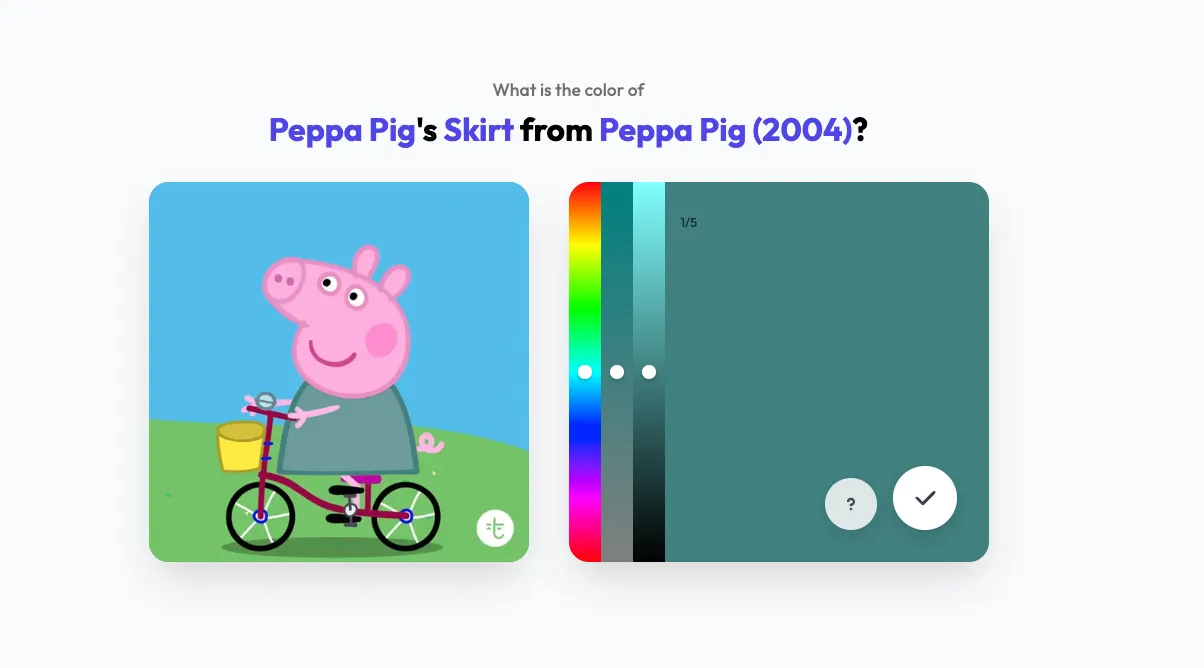
- You are shown five character-based prompts. Each round asks for the color of a character part from a source.
- You adjust H/S/B values. The visible controls use Hue, Saturation, and Brightness-style values such as
H200 S50 B50. - Your selection is locked in when you submit. The game then compares your chosen color against the original.
- The original color is revealed after your guess. You can see how your memory drifted from the actual shade.
- Your score reflects accuracy. Better matches produce stronger results, and leaderboard play gives the game a competitive bite.
The real catch is not knowing the character. The real catch is remembering the character’s color precisely enough to survive the sliders.
Visual example:
Prompt: What is the color of a character part?

Your selection:
H200 S50 B50

Original:
H195 S45 B70

What went wrong:
Close hue, but your brightness was too low.
That tiny difference is the whole battle. Toon Tone games turns nostalgia into measurement.
How To Play Toon Tone games?
Step 1 — Read the character prompt
Player Sees: A question asking for the color of a specific character part.
Prompt: What is the color of [character part] from [source]?
What You Learn: This is not just about naming the character. You need to remember the exact shade attached to that character detail.
Step 2 — Build your color with H/S/B
Player Action: Adjust the color controls.
Hue:        Which color family?
Saturation: How intense or muted?
Brightness: How light or dark?
What This Means: A good guess needs all three parts. Getting the hue right but the brightness wrong can still miss the target.
Step 3 — Submit your selection
Player Guesses: A color that feels right from memory.
Your selection: H200 S50 B50
Confidence: medium-high
Danger: childhood memory may be lying
Game Response: Toon Tone games reveals the original value and your score.
Step 4 — Compare against the original
Result Example:
Your selection: H200 S50 B50
Original:       H195 S45 B70
Lesson:         hue was close, brightness was too low
What This Means: You were in the right color neighborhood, but the real shade was brighter and slightly less saturated.
Step 5 — Chase a better score
The game tracks performance across multiple character prompts, with leaderboard competition adding pressure. Each round becomes a mini color exam: did you remember the character, or only the idea of the character?
Strategy & Tips
- Start with the character memory, not the slider. Picture the character first, then translate that memory into color.
- Lock the hue family before tweaking details. Decide whether the shade leans blue, cyan, green, orange, red, or purple.
- Brightness is the silent killer. Many guesses feel wrong because they are too dark or too pale, not because the hue is totally off.
- Do not over-saturate everything. Cartoon colors are vivid, but not every iconic shade is pure neon.
- Compare your miss after every round. If the original shows
B70and you guessedB50, remember that character’s shade as brighter next time. - Use memory anchors. Think in reference colors: sky blue, deep teal, banana yellow, tomato red, soft peach, or shadow purple.
Toon Tone games works because it weaponizes nostalgia. You think you know these characters by heart — then the color sliders ask for proof.